SWMS vs JSA (vs toolbox talk): which one does the law require?
Current at 2 November 2026 — reviewed against Safe Work Australia's SWMS information sheet and the model WHS Regulations (Safe Work Australia consolidation, 5 December 2025).
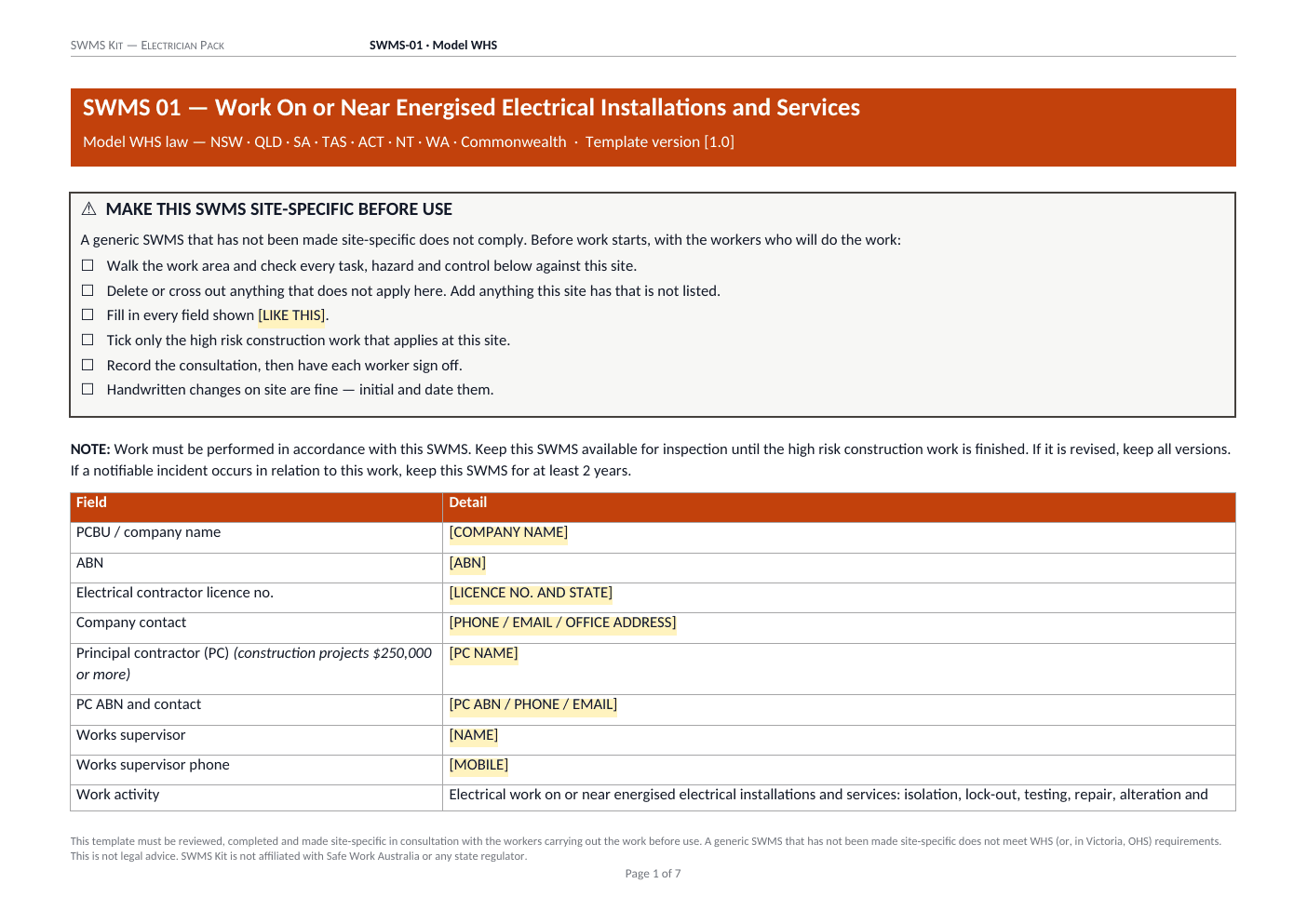
As at 2 November 2026, only one of these documents is a legal requirement in Australia: the SWMS, and only for high risk construction work (the 18 model-law categories, 19 in Victoria). A JSA (job safety analysis, also called a JHA) is a general risk-assessment tool with no legal trigger — good practice, but no regulation prescribes it, and it cannot substitute for a SWMS. A toolbox talk is a briefing, not a risk document. Safe Work Australia's own guidance draws the line: a SWMS "is generally different from other documents that focus on specific tasks or processes, such as a Job Safety Analysis".
The three documents, side by side
| SWMS | JSA / JHA | Toolbox talk | |
|---|---|---|---|
| Legal status | Required by regulation before high risk construction work (model reg 299; VIC OHS Regulations 2017) | Not a legal instrument — no regulation prescribes it | Not a legal instrument — a communication practice |
| Trigger | Any of the 18 HRCW categories (19 in VIC) — e.g. energised electrical work, falls over 2 m, trenches over 1.5 m | Whenever you choose to analyse a task's risks | Site routine — daily/weekly, or before a task |
| Scope | Construction-specific: the HRCW, its hazards, controls, and how controls are implemented, monitored and reviewed | Any job in any industry, broken into steps with hazards and controls per step | One topic, briefly — often walking the crew through a SWMS or a hazard of the day |
| Who prepares it | The PCBU/employer doing the work, in consultation with the workers — who signs a SWMS | Supervisor or worker doing the task | Supervisor/leading hand delivers; workers sign attendance |
| Must work follow it? | Yes — if work departs from the SWMS it must stop until the SWMS is followed or revised (model reg 300) | No statutory stop-work duty attached | No — it's a briefing record |
| Given to the principal contractor? | Yes, before work starts on $250k+ construction projects (model reg 301) | Only if the PC's own system asks for it | Attendance records often kept on site |
When you need which
- The task is high risk construction work → a SWMS, full stop. Run the free pre-start checklist if you're not sure the task qualifies.
- The task is risky but not HRCW (say, bench work, deliveries, non-construction maintenance) → no SWMS required; a JSA or other risk assessment is a sensible way to meet your general risk-management duty.
- The crew needs the plan in their heads before starting → a toolbox talk, walking through the SWMS — the Electrician SWMS Kit ships 5 toolbox talk templates alongside its 8 SWMS for exactly this.
The common (and costly) mistake: submitting a JSA when a SWMS is required
Plenty of tradies carry a generic "JSA" or "JHA" form from a past employer and hand it to the builder for every job. Two problems. First, if the work is HRCW, the regulation requires a document that does four specific things — identify the HRCW, state its hazards and risks, describe the controls, and describe how the controls are implemented, monitored and reviewed. A JSA typically has no HRCW identification at all, so it fails on its face, and in Queensland that gap has a number on it: up to 60 penalty units under reg 299. Second, the principal contractor's paperwork check is exactly where this surfaces — the PC must obtain your SWMS before HRCW starts, and a form titled "JSA" with no HRCW checklist is one of the fastest knock-backs on a commercial site.
The reverse mistake exists too: writing a 30-page SWMS for work that isn't HRCW. Regulators explicitly discourage padding — a SWMS is only required for the listed categories, and a lengthy SWMS is harder to use, monitor and review.
SWMS vs JSA questions
What's the difference between a SWMS and a JSA?
A SWMS is legally required before high risk construction work; a JSA is a voluntary risk-analysis tool for any task. Different trigger, different legal weight.
Can a JSA be used instead of a SWMS?
Not for high risk construction work. The regulation prescribes the SWMS's content; a JSA doesn't meet it, and PCs reject the swap.
Is a JSA a legal requirement?
No specific regulation requires one. It's one common way to meet the general duty to manage risks for non-HRCW tasks.
Do I need both for the same task?
Usually no — if it's HRCW, the SWMS is the document. Duplicating it as a JSA just multiplies paperwork that must be kept consistent.
Need the SWMS side sorted?
The Electrician SWMS Kit covers the 8 electrical jobs that count as HRCW — 21 editable documents including 5 toolbox talk templates, Model WHS + Victorian versions, A$59.
Or start with the free pre-start SWMS checklist.